These are the links to the Romanian Multicultural Stories Book. I uploaded each story separately.
http://www.scribd.com/doc/38406902/Romania-Story-An-amazing-journey
http://www.scribd.com/doc/38406802/Reunion-Island-Story-Captain-Tamoul-around-the-world
http://www.scribd.com/doc/38406741/Portugal-Story-A-ghost-in-Colegio-do-Sardao
http://www.scribd.com/doc/38406635/SPAIN-Story-The-bullfighter-Manuel
http://www.scribd.com/doc/38406309/Finland-Story-Looking-for-Santa-Claus
http://www.scribd.com/doc/38406261/England-Story-Cultural-dinosaur-adventure
http://www.scribd.com/doc/38406233/Turkey-Story-The-secrets-of-the-forest
Showing posts with label Romania. Show all posts
Showing posts with label Romania. Show all posts
Wednesday, 29 September 2010

Tuesday, 28 September 2010


Friday, 10 September 2010
MULTICULTURAL GAMES BOOKLET
Here you can find our multicultural games booklet. I hope you like it.
www.scribd.com/doc/37212793/Multicultural-Games-Booklet
www.scribd.com/doc/37212793/Multicultural-Games-Booklet
Sunday, 22 August 2010
TRADITIONAL RECIPES BOOK
Here you can find the book with all our traditional recipes (I, II, III)
Dorina
Dorina
TRADITIONAL SONGS BOOK
Here you can find the Traditional Songs Book I made.
www.scribd.com/doc/36257365/Traditional-Songs-Book
www.scribd.com/doc/36257365/Traditional-Songs-Book
SHORT STORIES BOOK
This is the Romanian short stories book.
http://www.scribd.com/doc/36256992/Short-Stories-Book
http://www.scribd.com/doc/36256992/Short-Stories-Book
COMENIUS PROJECT PRESENTATION
Hi everyone
This is the presentation I've made for the final dissemination of the project at our school. I hope you like it.
http://www.scribd.com/doc/36256252/Prezentare-Proiect-Comenius-We-Europeans-Have-a-Bagful-of-Culture-to-Share
This is the presentation I've made for the final dissemination of the project at our school. I hope you like it.
http://www.scribd.com/doc/36256252/Prezentare-Proiect-Comenius-We-Europeans-Have-a-Bagful-of-Culture-to-Share
Thursday, 22 April 2010
THE IMPORTANCE OF A HEALTHY BREAKFAST
Today the pupils from class 4D had a very interesting activity. Their teacher (Mrs. Scriosteanu) invited an official from the The Health Promotion Office to discuss about the importance of a healthy breakfast.
The children learned how to read and interpret the ingredients list of a product, they cooked a healthy breakfast and they wrote the recipe of an ideal combination of cereals for breakfast. After that, a team of "experts" (also pupils) analyzed the food presented by all the teams and then they made collages with types of food that can be eaten at breakfast.
At the end of the activity the children enjoyed the food they prepared.


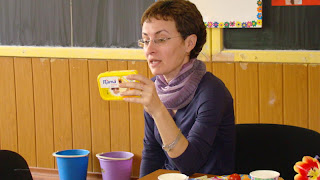


The children learned how to read and interpret the ingredients list of a product, they cooked a healthy breakfast and they wrote the recipe of an ideal combination of cereals for breakfast. After that, a team of "experts" (also pupils) analyzed the food presented by all the teams and then they made collages with types of food that can be eaten at breakfast.
At the end of the activity the children enjoyed the food they prepared.


Wednesday, 24 March 2010
ROMANIAN PUPILS SINGING THE TURKISH SONG
They are Sezen and Elida and they are in the 4th grade. They sing very well, don't you think?
Friday, 13 November 2009
"Eating healthy, growing beautifully"
This activity was part of a project entitled: "Eating healthy, growing beautifully", whose goal was to encourage children to eat healthy food. There were two sketches, one played by the 8th grade and one by the 4th grade.
The sketch of Class 4 D was called: "Vitamin C" and it was about a child who brought a law suit against Vitamin C. After the sketch the children took part in a raffle and won fruit and vegetables.


The sketch of Class 4 D was called: "Vitamin C" and it was about a child who brought a law suit against Vitamin C. After the sketch the children took part in a raffle and won fruit and vegetables.


Saturday, 20 June 2009
THE JAPANESE TEA CEREMONY
Class 1 C, Mrs. Mateescu's class, had a very special activity at the beginning of June. It was an activity about the Japanese tea ceremony. The children learned a lot of interesting things about this ceremony and tried to perform one in their class. They had a lot of help from their teacher and parents, of course, but it's their work. Here are some of the things they found out:
The tea ceremony played an important role in Japan’s cultural and artistic life for more than 400years. It is an art and a way of disciplining the soul. The people who gather to take part in the ceremony have to leave outside all the problems and the worries of the everyday life in order to spend some quiet moments in a calm atmosphere;
A complete ceremony lasts 4 hours, includes serving cookies and serving tea twice. The host must do everything to create an aesthetic, intellectual and psychical comfort for the guests.


Mrs. Dragnea, our headteacher, was a special guest at the ceremony.

Another class, 3B, made drawings of the whole activity.

The tea ceremony played an important role in Japan’s cultural and artistic life for more than 400years. It is an art and a way of disciplining the soul. The people who gather to take part in the ceremony have to leave outside all the problems and the worries of the everyday life in order to spend some quiet moments in a calm atmosphere;
A complete ceremony lasts 4 hours, includes serving cookies and serving tea twice. The host must do everything to create an aesthetic, intellectual and psychical comfort for the guests.
oThe ceremony has the role to turn the guests attention to the beauty of nature, water, light, fire;
oThe conversation in the tea room will only be about these things; the guests will not chat in groups, they will speak highly of the host’s utensils and grace, of the tea ritual.
oAs far as clothing is concerned, most of the times it is used the kimono; the clothes must have simple patterns and be very clean;
oThe body movements must be harmonious, serene and calm;
oVery important is also the way you move, sit down, pour the tea, hold the tea cup;
These are the fundamental principles of the tea ceremony:
o Harmony – Wa – Harmony must be created between people, between objects, between people and objects. The order and disposition of objects in a certain way creates harmony.
o Respect - Kei – Respect for a rule, for the instruments of the ceremony, for other people and self-respect.
o Purity - Sei – Interior purity and the purity (cleanliness) of the things around us.
o Tranquility - Jaku – If all the above principles are respected, you get serenity and calm.
Here are some pictures from the activity:


Mrs. Dragnea, our headteacher, was a special guest at the ceremony.

Another class, 3B, made drawings of the whole activity.

Friday, 24 April 2009
News from Class IV B - Gh. Titeica
Geography evaluation test on the beach.
Our teacher had the idea of checking our geography knowledge outside the classroom, in a more relaxing environment. We went to the beach where she hid the tickets with questions from our last Geography class in the sand. We were divided into groups and started looking for the tickets. Each member of the group had to answer to a question.


Two groups had the most correct answers.


In the end we all enjoyed the fresh air and the sea breeze skipping the rope.


Our teacher had the idea of checking our geography knowledge outside the classroom, in a more relaxing environment. We went to the beach where she hid the tickets with questions from our last Geography class in the sand. We were divided into groups and started looking for the tickets. Each member of the group had to answer to a question.


Two groups had the most correct answers.


In the end we all enjoyed the fresh air and the sea breeze skipping the rope.


Tuesday, 7 April 2009
News from Class IV A - Gh. Titeica - Romania
Our classmate, Maria Pirvanescu took part in a painting competition called “Spring Rhapsodies” organized for the most talented little artists aged 9-10. She won the first prize. Her remarkable talent has been rewarded with prizes in national and international contest since 2005. Here are some photos with her receiving the prize and of course, her wonderful painting.


Wednesday, 1 April 2009
NEWS FROM ROMANIA - CLASS 5D
Easter Workshop
One of the most beautiful Romanian Easter traditions is painting the eggs. Our Religious Education teacher had the great idea of teaching us how to paint eggs. We brought fresh white eggs and red, yellow and orange food dye. Our teacher brought an implement called a condei or chisita (a small wood stick with a sharp point at the end) used for drawing patterns on the eggs and some melted wax. We started our workshop activities. Here are the steps:
- Blowing eggs: Wash the egg and prick top and bottom with a thick needle or hatpin. Peel away a little shell at the base. Holding the egg over a bowl, seal your lips over the top and blow hard. The white and yolk of the egg will come out in a rush! Rinse the shell carefully in cold water and prop up to dry.

- Painting eggs: Heat the melted wax. Dip the “condei” in the wax and cover the little holes made by the needle. Then paint patterns.


- Dying eggs: Dilute food dye in hot water. Dip eggs in dye (first yellow, then red and so on) .The wax seals the dye so you can dip the egg in several colours without them running into one another.

- Cleaning the wax: Heat the painted egg a little. Wipe it with a piece of warm soft cloth.
Our work is ready. Do you like our painted eggs?


Subscribe to:
Posts (Atom)